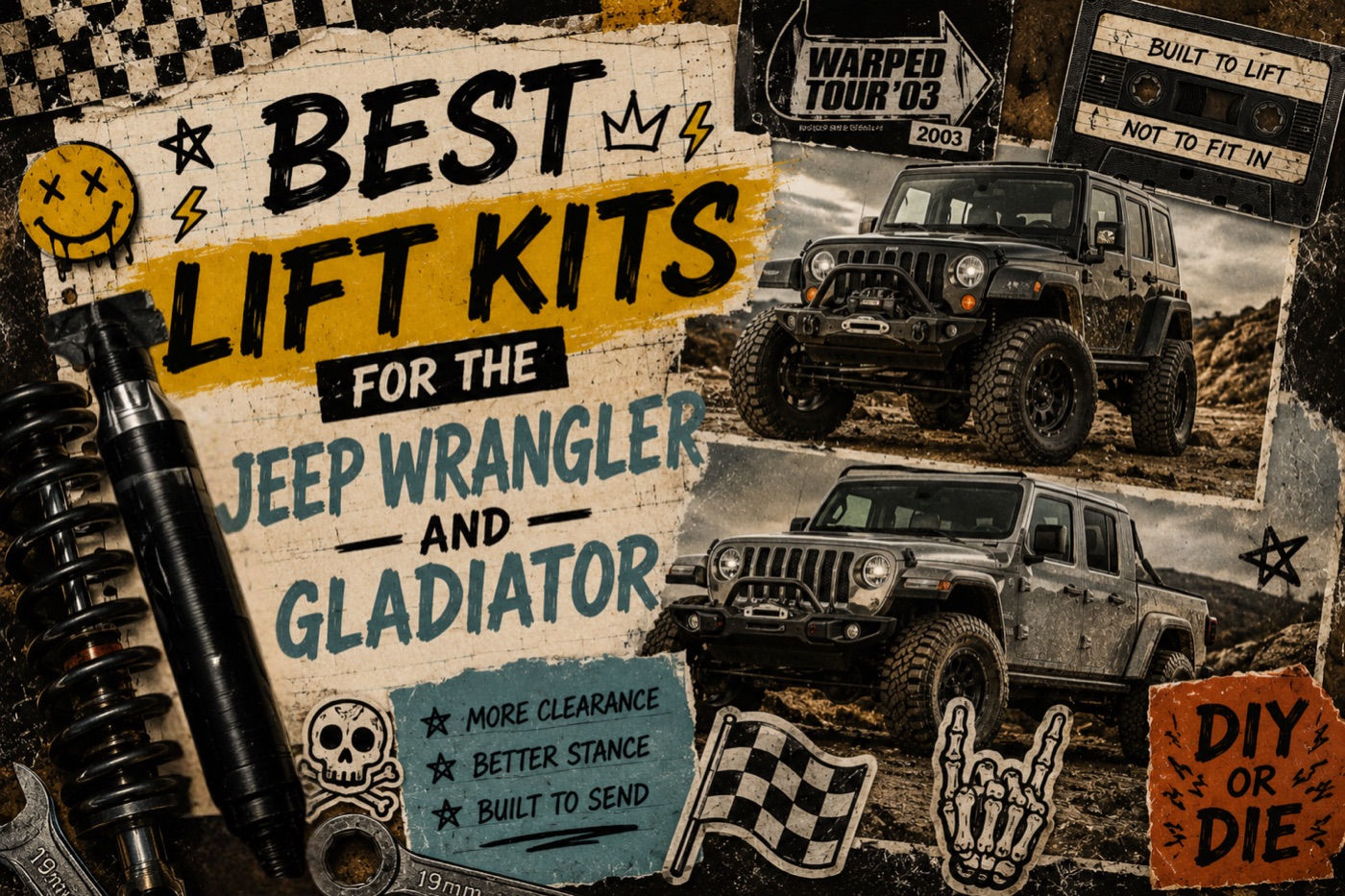
Best Lift Kits for the Jeep Wrangler and Gladiator: From Street Stance to Full Send
No vehicle has a longer, deeper lift kit aftermarket than the Jeep Wrangler. The options are endless, which is both the best and worst thing about buying a lift for a Jeep. Here's how to cut through the noise.
The Wrangler and Gladiator share core suspension architecture and much of their lift kit compatibility, but they're not the same truck. The Gladiator's longer wheelbase and truck bed change the rear suspension dynamics in ways that matter for lift kit selection. This guide covers both, with clear callouts where they diverge.
Wrangler / Gladiator Lift Kit Quick Reference
| Lift Height | Tire Size | Best For | Notes |
|---|---|---|---|
| Leveling / 1"-2" | Up to 33"-35" | Stock+ stance | Minor lift for larger tires. Most common entry point. |
| 2.5"-3.5" | 35"-37" | Trail-ready daily | The Jeep sweet spot. Bolt-on for most JL/JT builds. |
| 4"-6" | 37"-40" | Serious trail / rock | Long-arm territory begins here. Driveshaft angles matter. |
| 6"+ | 40"+ | Full build | Long arm, aftermarket diffs, extended everything. |
Wrangler Generations: TJ vs JK vs JL
TJ (1997-2006)
The TJ is a classic platform with one of the most mature lift kit markets of any off-road vehicle. Options range from simple budget spacer lifts to long-arm suspension systems. The TJ uses a solid front axle setup (unlike the independent front suspension on trucks), which means lift kits work differently here. Coil spring spacers and full coil replacements are the main mechanisms, not strut spacers.
The TJ is an older platform and most active buyers in this segment are building dedicated trail rigs. Budget lifts are abundant but quality variance is real. A poorly engineered TJ lift affects caster, death wobble risk, and driveshaft angles significantly.
JK (2007-2018)
The JK was Wrangler's highest-volume generation and has the deepest aftermarket of any Jeep platform. Two-door and four-door (Unlimited) configurations have the same suspension setup. JK lift kits are extremely well-developed at every price point.
Death wobble is a real phenomenon on JKs at higher mileages, and a lift install on a JK with worn steering components can amplify it. Before lifting a high-mileage JK, inspect track bar, tie rod, and drag link condition. A clean install on worn components is a bad outcome.
JL (2018-Present)
The JL Wrangler updated the suspension significantly, improving on-road driving dynamics and adding an optional electronic front sway bar disconnect (Sky One-Touch and certain Rubicon configurations). JL kits are well-developed and widely available. The JL is a better daily driver than the JK, and most lift installs maintain that quality with the right kit selection.
The Rubicon JL already has factory disconnecting sway bars and a factory 1" lift advantage. Many Rubicon owners go straight to 2.5"-3.5" lifts to run 37s without needing a full long-arm setup.
Gladiator (JT): Where It Differs
The Gladiator (JT) shares the JL front suspension but has a different rear suspension tuned for truck duty. The longer wheelbase and bed structure also affect driveshaft angles at lift heights above 3.5 inches more significantly than the JL.
Most JL lift kits that specify Gladiator compatibility have been reengineered for the JT's rear. Don't assume a JL kit fits a Gladiator without explicit Gladiator confirmation in the kit listing. The front will bolt on. The rear may not be optimized.
The Gladiator Mojave has factory Fox shocks and a desert-rated suspension setup. Lift kit options for the Mojave are more limited. Confirm Mojave-specific fitment before ordering.
Short Arm vs Long Arm Lifts
This distinction matters most on Jeeps and almost nowhere else in the half-ton truck world.
- Short-arm lifts (up to ~3.5"): Use the factory control arm mounting locations. Bolt-on install. Maintains factory driveshaft angles within acceptable range. Best for most daily-driven trail rigs running 35"-37" tires.
- Long-arm lifts (4"+): Relocate the lower control arm mounting points to correct geometry at taller lift heights. Significantly more complex install, often requires cutting and welding or specialized brackets. Required for reliable performance at 4"+ with larger tires.
For most Wrangler and Gladiator buyers who want a capable trail rig they also drive daily, a quality 2.5"-3.5" short-arm lift running 35"-37" tires is the most balanced build. It's enough for 95% of trails, doesn't require driveshaft surgery, and doesn't destroy highway ride quality.
Tire Sizing on the Wrangler / Gladiator
The Wrangler has the most forgiving tire fitment of any vehicle in this guide, thanks to its boxy body and generous fender clearance.
- 33s: Fit stock or with minimal leveling on most trims. Clean bolt-on.
- 35s on 2"-2.5" lift: Standard Wrangler build. Works on JK, JL, JT. Minor trimming on Sport and Sport S models. No trimming typically needed on Rubicon.
- 37s on 3.5" lift: Achievable on Rubicon without long-arm. Requires minor fender trimming on non-Rubicon JL/JK. Inner fender liner and plastic trim pieces are the usual contact points.
- 40s on 4"+: Long-arm territory. Requires fender flare modification or replacement.
Lifting a Wrangler or Gladiator? Liftnasium lists Wrangler and Gladiator kits by generation with clear short-arm vs long-arm callouts. Find your platform's exact fit and know what you're getting before you wrench.