It Was Never A Phase
We still have the burned CDs. We know exactly where they are. This is not a coincidence.
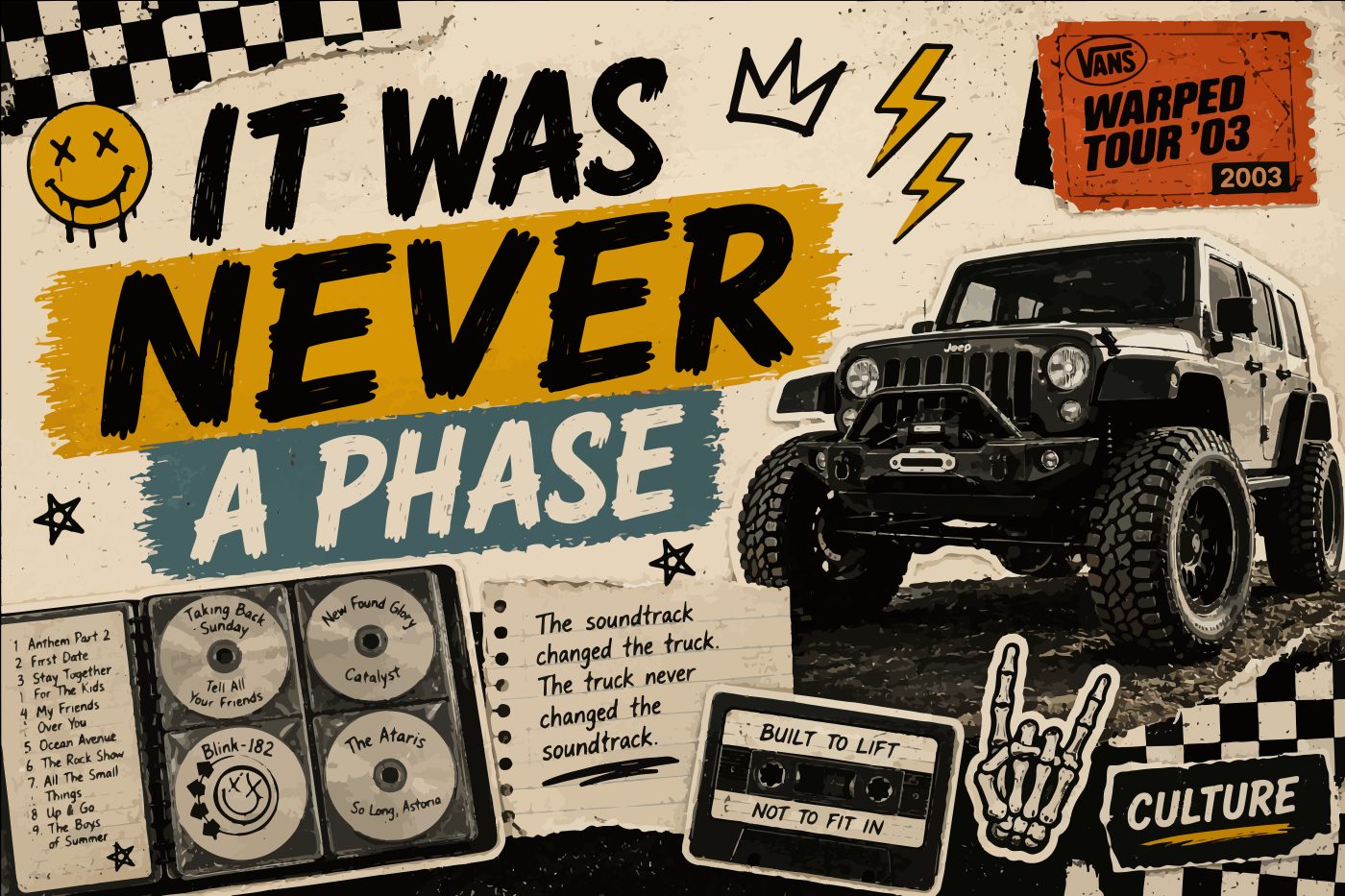
The binder lives under the desk in the third bedroom, the one that became an office when the kids needed their own space. Hard plastic cover gone soft at the corners from years of being shoved into backpacks. Inside: somewhere north of two hundred burned CDs, each one labeled in Sharpie in handwriting we'd recognize anywhere. Track lists written on the inside of every case. Most of the ink still legible.
The binder has moved through four apartments and two houses. It survived two storage units, at least one serious conversation about what actually needs to come with us, and whatever you'd call the years in between. It has always come with us.
On the other side of the wall, in the garage, there's a truck on jack stands. The rear differential is exposed. The smell of penetrating oil has been in the air since Thursday. On the workbench there's a tablet propped against a socket set, paused on a disassembly video, and a phone playing a playlist that anyone who graduated between 1998 and 2008 would recognize without being told what it is. The songs are not ironic. They are not nostalgic in the way that implies distance. They are just what's on.
The binder has moved through four apartments and two houses. It has always come with us.
The Thing About Phases
A phase, by definition, passes. The assumption baked into the word is that on the other side of it you become something more settled, that the energy you spent on the thing you loved so hard at fourteen gets redirected toward something with better long-term returns.
Nobody accounted for us.
We arrived at our late thirties with the exact same taste we had at fifteen, refined but not replaced, and assembled lives that accommodate it rather than apologize for it. The record collection kept growing. The show ticket kept getting purchased. The Saturday morning kept getting cleared for whatever the truck needs this week.
Ask us about it and we'll shrug. It's just what we're into. As though the continuity is unremarkable. As though it hasn't required a kind of quiet, persistent stubbornness to remain exactly who we were in the face of considerable social pressure to become someone more legible.
The pressure was real. It came from everywhere and it came early. You'll grow out of it. That's a phase. Very cute. The condescension was well-meaning, mostly. It assumed that the thing we loved so specifically, so intensely, it assumed that thing was a temporary miscalibration. Something that would sort itself out.
It didn't sort itself out. We didn't want it to.
The Language of the Thing
There was a moment, maybe you remember yours, when we first understood that the music was also a social infrastructure. That knowing the right bands meant knowing the right people. That taste was a kind of fluency. The show was never just a show. It was a census.
The truck community runs on the same operating system. Pull into the right parking lot, at the right event, with the right setup, and something happens that's hard to explain to anyone who hasn't been there. People clock the build before they clock you. The approach is always the same: a glance, then a second look, then the walk-over with the chin-up nod that means the conversation is about to start. What year is it. What lift. What tires. The questions that are actually a handshake.
It's fluency. The same fluency, expressed through a different vocabulary. The part of us that can hear four notes and name the album and the year is the same part that clocks a wheel offset from a hundred feet away and knows immediately whether it's right. We didn't develop two separate skill sets. We developed one skill set and found two places to use it. Attention. Specificity. The genuine desire to know the thing rather than just know about it.
The show was never just a show. It was a census. We just learned to read the same room in a parking lot.
What the Garage Sounds Like
On a good Saturday, when the weather is right and the job is something satisfying rather than something urgent, the garage has a specific quality of time. It moves differently than the rest of the week. There's no inbox in the garage. The notifications stop mattering. The problem in front of us is real and physical and has a correct answer that we either find or we don't, and the difference is entirely a function of how much attention we pay.
The playlist is not incidental to this. It's structural. The right songs at the right volume create a specific kind of focus, not the focus of a quiet room, but the focus of a room that's loud in a way we chose, in a way that means something, in a way that puts us in a particular relationship with our own history. The song that was playing the first time we drove somewhere alone. The album that got us through the worst six months we can remember. All of it in there, queued up and running, while we figure out what the suspension is trying to tell us.
The garage is not where the scene kid went to become someone else. It's where the scene kid went to be exactly themselves, in a room of their own making, with the music they actually love and the problem they actually want to solve. We built Liftnasium in that room. We're still in that room. The binder is under the desk. The truck is on the stands. The playlist is still right.
None of this was ever a phase.
Still the same people. Still won't take stock. Find lift kits for your exact truck at Liftnasium. Verified fitment. No fluff.