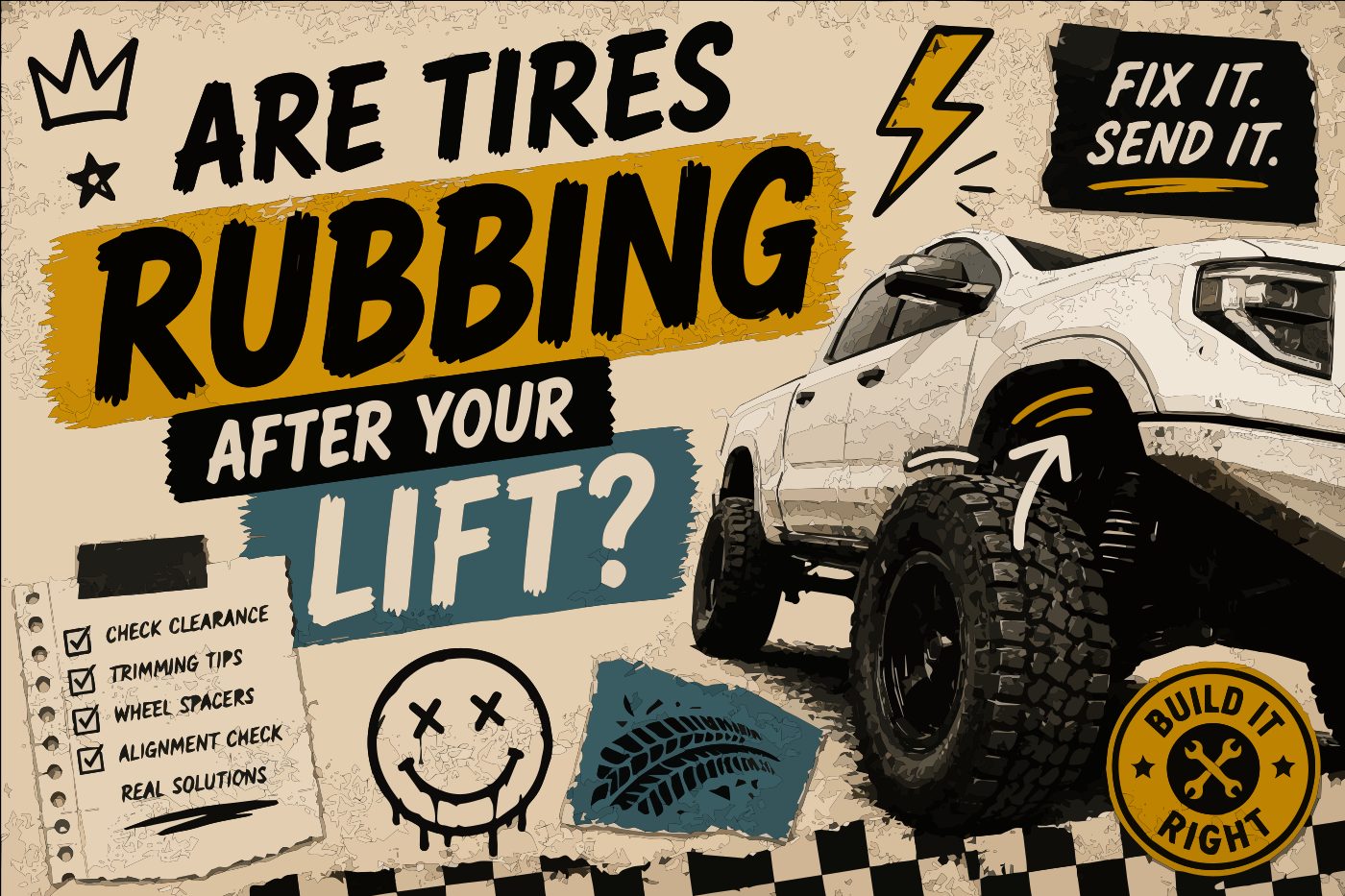
Tires Are Rubbing After Your Lift. Here's How to Diagnose and Fix It.
You did everything right. You picked the kit, did the install, got the alignment. Now you're on the highway and there's a rub at full steering lock. Or worse, a rub at center that gets louder on the freeway.
Tire rub is one of the most common post-lift complaints, and it's almost never a sign that something is broken. Usually it's a clearance issue with a specific fix. This guide walks you through diagnosing where the rub is coming from and what to do about it.
First: Identify When and Where It's Rubbing
Tire rub almost always falls into one of four scenarios:
- Rub at full steering lock only: This is the most common and least concerning. It usually means your tire is contacting the factory bump stop, inner fender liner, or UCA at the limits of steering travel. If it only rubs when you're cranking into a parking space, it's likely livable or fixable with a small trim.
- Rub over bumps: If you hear or feel rubbing when you hit a dip or pothole, your tires are likely contacting something at full compression, usually the inner fender or factory bump stop. This is a clearance issue at the top of suspension travel.
- Rub at highway speed (no turning, no bumps): This is a balance or runout issue, not a clearance issue. If it's rhythmic, especially if it changes with speed, check wheel balance and tire runout before assuming it's a fitment problem.
- Rub any time the wheel is turned past center: This typically points to inadequate lift height for the tire size, or an offset issue with your wheels. The tire is physically too wide or too tall for the available clearance.
The Most Common Fix: Trimming the Liner
For rub at lock or over bumps, the first fix to try is trimming the inner fender liner. This is plastic, not structural, and removing a small section to clear the tire does not affect function.
How to find the rub point:
- Clean the inner fender area thoroughly.
- Apply chalk or chalk spray to the inside edge of the tire.
- Have someone crank the steering to lock while you watch, or just drive slowly through a full lock maneuver.
- The chalk transfer marks show you exactly where contact is happening.
Once you've identified the rub point, use a utility knife or rotary tool to remove just enough liner to clear the tire. Take off a little at a time, check clearance, repeat. You want at least 1/2 inch of clearance at the identified contact point. More is better.
Wheel Offset as a Factor
If you changed wheels along with the lift, offset is often the culprit. A wheel with too much negative offset pushes the tire outward, which can cause outer fender contact. Too much positive offset pulls it inward, which causes UCA and inner liner contact.
Check your offset against what your lift kit recommends for your tire size. Most lift kit documentation specifies a recommended offset range. If your wheels are outside that range, no amount of trimming fully resolves the rub.
Bump Stop Extensions
If your rub happens at full suspension compression (over bumps), extended bump stops are worth considering. They limit suspension travel before the tire contacts the fender, acting as a mechanical stop before you reach the problem zone.
This is a common addition to 3-4 inch lift builds running larger tires on pavement. You sacrifice a small amount of droop travel to prevent contact at full compression. Most people don't notice the difference unless they're actively wheeling.
When Trimming Isn't Enough
If you've trimmed the liner, confirmed the offset is correct, and the rub persists, the likely answer is one of the following:
- Your tire is too large for your lift height. The fix is either a taller lift or a smaller tire. There's no trimming your way out of a fundamentally mismatched tire-to-lift ratio.
- You have a worn or failed alignment component. A bent control arm or a ball joint that's shifted can bring the tire closer to contact points after a lift install. Have a shop inspect the geometry.
- Your lift kit isn't designed for your specific trim. Some kits are designed for base trims and don't account for factory skid plates, tow packages, or off-road editions that have different lower control arm positioning.
Prevention: Get It Right Before You Install
The single best way to avoid post-lift rub is to verify tire-to-lift fitment before you buy. Real-world clearance data from other builders running your exact truck, lift height, tire size, and wheel offset is more valuable than any clearance calculator.
At Liftnasium, every kit listing includes confirmed tire size ranges and notes from real installs, including whether minor trimming was required. If the kit needs trimming, we tell you upfront instead of letting you find out in a parking lot.
Still have a fitment question? Every Liftnasium product listing includes confirmed tire sizes and real-builder notes. Check your truck's fitment data before you buy, or after, if you're already in the weeds.